

Share


An SMM panel is an online dashboard where you can buy and manage social media services such as followers, likes, views, comments, shares, subscribers, and reactions from a single account. SMM stands for Social Media Marketing, and the word "panel" refers to the dashboard you log in to place and track those orders.
However, it does not control social media algorithms or replace useful content, paid advertising, and genuine audience relationships.
That is the short answer. The longer answer is more useful because most people who search this question aren't really asking for a definition. They are asking whether it works, whether it is safe, and whether it is worth their money.
I have spent a lot of time inside these dashboards, both as a buyer and on the operations side. So I wrote this guide the way I would explain it to a friend about to spend their first five dollars. No hype, no promises of overnight growth, just what a panel actually does and where people usually go wrong.
TL;DR
- An SMM panel is an ordering dashboard for social media services, not a social network and not a marketing strategy.
- You sign up, add funds, pick a service, submit a public link, and track the order status.
- Panels cover Instagram, YouTube, TikTok, Facebook, Telegram, LinkedIn, X, Spotify, Discord, Pinterest, and more.
- Most panels are resellers connected by API to larger providers, which is why prices are so low.
- Using a panel isn't illegal in most countries, but artificial engagement can violate a platform's Terms of Service.
- Real risks: bot followers, drops, wasted budget, unnatural growth patterns, and account restrictions.
- Safe use looks like this: place a small test order, deliver gradually, read the service description, check the refill policy, and never share your password.
What Does SMM Panel Actually Mean?
Break the term into two halves, and it stops sounding technical.
SMM is Social Media Marketing. That covers everything brands do on Instagram, YouTube, TikTok, Facebook, LinkedIn, and X to get seen, from content and hashtags to paid ads.
Panel is the dashboard. It is the same word people use for a hosting control panel or an admin panel: one login, a service list, a balance, an order form, and a history page.
Put them together, and you get a website where social media services are listed like products in a store. You pick "Instagram Reels Views," enter your video link, choose 5,000, and pay from your panel balance. The panel records the order, gives you an order ID, and shows you a status while the service is delivered.
An SMM panel is not the same as social media marketing.
This is where a lot of beginners get confused, so it is worth saying plainly.
Social media marketing is the whole discipline: content strategy, posting schedule, community management, creative testing, paid campaigns, analytics. An SMM panel is one narrow tool inside that world. It sells you a number. It does not sell you an audience.
You can have both. You can run a real content plan and use a panel to warm up a new page. What you cannot do is replace the first with the second and expect it to hold up.
The three layers are easier to understand when separated:
This distinction prevents a common misunderstanding. If a panel marks an order as completed, it means the delivery system considers that particular order fulfilled. It does not prove that the platform will recommend the content or that viewers will become customers.
What Is an SMM Panel Used For?
People use SMM panels for different reasons. A new creator wants early activity on a video. A local business wants a page to look less empty before a promotion. An agency needs one place to organize many client orders. A reseller wants an API or child panel to run a separate storefront.
Common uses include:
- Ordering followers for a profile, page or channel
- Adding likes, reactions, views, comments, shares or saves to selected content
- Supporting a new post, Reel, Short, livestream, or campaign launch
- Managing services across several social networks from one balance
- Handling bulk or mass orders for multiple client links
- Spreading delivery through a drip-feed schedule when the service supports it
- Replacing eligible drops through a refill request
- Automating reseller orders with an SMM panel API
- Testing a small quantity before deciding whether to scale
The useful question is not simply, “Can I buy this metric?” It is, “What business or content goal is this metric meant to support?”
For example, 1,000 video views may change the displayed view count. If the real goal is product sales, you still need a relevant audience, a persuasive video, a clear offer, and conversion tracking. The ordered metric and the business outcome are related only when the wider strategy connects them.
How Does an SMM Panel Work?
Most panels follow a similar order process, although the exact interface and rules can differ.
1. Define the Goal
Start with the result you can actually measure. Do you want activity on one post, a higher follower count, more channel members, or a gradual campaign across several pieces of content?
A specific goal makes it easier to choose the right service. “Grow my account” is vague. “Test 500 views on one public video and review the delivery” is measurable.
2. Create an Account
Sign up, and you get a dashboard. That is where everything lives: the service list, the order form, your balance, your order history, the support section, and your API key if the panel offers one.
Use a fresh email and password here. Your panel login has nothing to do with your Instagram or TikTok login, and it should stay that way.
3. Add Funds
Panels run on a prepaid balance. You deposit once, and every order draws from that balance until it runs out.
Payment options depend on the panel and your country. SMMIU accepts bKash, Nagad, and Rocket for Bangladeshi users, along with Visa, Mastercard, and other international methods, with a $1 minimum deposit. Gateways and limits change, so check the live payment page before you send anything.
4. Select the Right Service
Services are usually grouped by platform and metric. Two items with similar names still have different minimum quantities, estimated start times, delivery rates, refill periods, or target requirements.
Before choosing, read the full description. Words such as “premium,” “targeted,” “fast,” “high retention,” or “non-drop” are marketing labels, not universal technical standards. Their meaning depends on the conditions attached to that individual service.
5. Submit the Correct Public Link
The order form wants a URL, and the right URL depends on the service. Follower services take a profile or channel link. View services need the exact post or video URL. Group and channel services need the community link.
Keep the target public until delivery finishes. A private account, a deleted post, a misspelled username, or the wrong URL will either stop the order or send it somewhere you didn't intend.
And for a standard public-link service, no panel needs your password or your two-factor code. Not for Instagram, not for Facebook, not for YouTube, not for anything.
6. Enter the Quantity and Place the Order
The user enters an amount within the service’s minimum and maximum limits. The dashboard calculates the cost from the current rate and deducts it from the balance after submission.
This is the final point to check the service ID, link, and quantity. Many processing orders cannot be edited or canceled once delivery has started.
7. Track the Status
You get an order ID, and that is how you follow it. Delivery might start in minutes or sit in a queue, depending on demand, order size, service type, and the state of your target.
One thing worth understanding: start time and completion time are different numbers. "Starts in 10 minutes" tells you when processing begins. It says nothing about when the last unit lands.
What Do SMM Panel Order Statuses Mean?
Status labels help users understand what is happening without contacting support for every update.
Labels can vary between panels. When a status remains unchanged beyond the listed timeframe, send the order ID to support rather than submitting duplicate orders.
What Services an SMM Panel Offers?
The live catalog determines what a panel actually offers. Some focus on a few major networks, while others include social platforms, messaging communities, music services, and website traffic.
Instagram SMM Panel Services

Instagram services target a profile, a feed post, a Reel, a Story, or a live session. Common options include:
- Instagram followers
- Post and Reel likes
- Reel and video views
- Story views
- Comments
- Saves and shares
- Live viewers
These metrics increase the visibility of activity around selected content. They do not replace strong visual creative, useful captions, consistent posting, or conversations with real followers.
YouTube SMM Panel Services

YouTube SMM Panel services contain:
- Video and Shorts views
- Subscribers
- Likes and comments
- Livestream viewers
- Watch-time-related services
Creators should be especially careful with monetization expectations. Ordering a number does not guarantee that YouTube will count it as valid public watch time, eligible engagement, or monetizable traffic. Thumbnail quality, click-through rate, audience retention and viewer satisfaction still shape long-term performance.
YouTube’s Fake Engagement Policy explains that artificially increasing views, likes, comments, or other metrics can violate its rules. Users should read the current policy before ordering any YouTube-related service.
TikTok SMM Panel Services

TikTok services commonly cover:
- Followers
- Video views and likes
- Shares and comments
- Saves
- Live viewers or live engagement.
TikTok moves quickly, but an early number cannot make weak content hold attention. The opening seconds, completion rate, rewatches, relevance, and creative idea remain important.
Facebook SMM Panel Services

Facebook SMM Panel services are available for pages, posts, Reels, videos, and groups. The catalog includes:
- Page likes and followers.
- Post reactions
- Video and Reel views
- Comments and shares
- Group members
- Livestream viewers
For local and e-commerce businesses, Facebook may also serve as a customer service and sales channel. Purchased metrics cannot replace genuine messages, reviews, product information, or fast responses to buyers.
Meta publishes rules on inauthentic behaviour and engagement and on spam that artificially increases viewership. Those rules apply independently of any panel’s service description.
Telegram SMM Panel Services

Telegram options support public channels and groups through:
- Channel or group members
- Post views
- Post reactions
- Poll votes
- Channel boosts
Community owners still need useful posts, moderation, and a clear reason for members to stay. A visible member count is not the same as an active community.
X, LinkedIn and Threads Services

Depending on availability, users may find profile followers, post likes, reposts, views, comments, impressions, or company-page followers for X, LinkedIn, and Threads.
Context matters here. LinkedIn is a professional network, so a large count beside weak or unrelated content can damage credibility instead of improving it. Useful expertise and real discussion should remain the center of a B2B strategy.
Spotify, SoundCloud, Discord and Other Services

Wider catalogs include Spotify plays, followers, and saves; SoundCloud plays or reposts; Discord members; Pinterest engagement; and website traffic.
Each platform measures activity differently. A play is not necessarily a fan, a Discord member is not automatically active, and a website visit is not a conversion. Judge each service by the metric it promises, not by outcomes it never claimed to provide.
SMM Panel Terms You Should Learn Before Your First Order
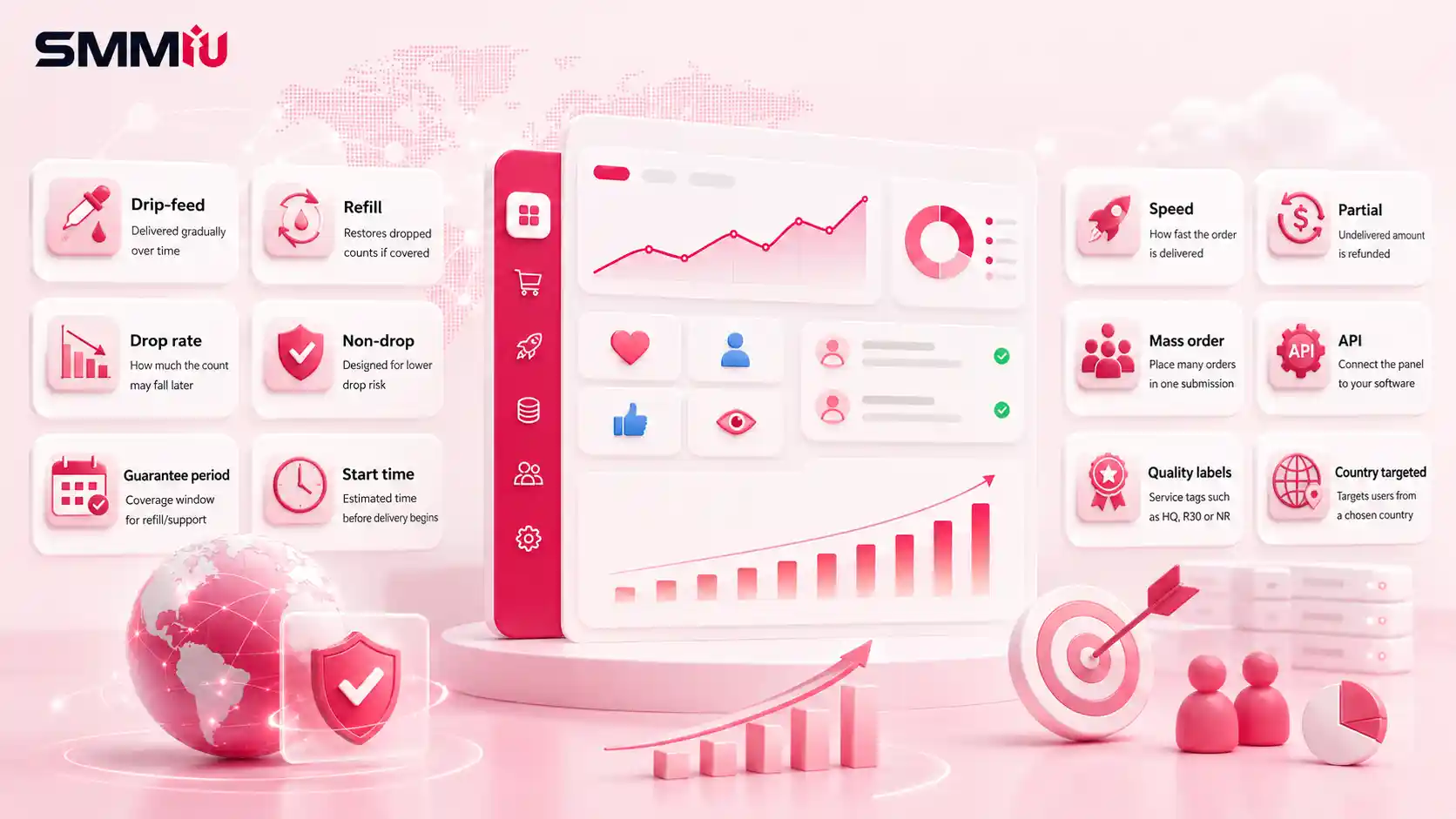
Panels use a shared vocabulary that nobody explains anywhere on the site. Learn these and service descriptions stop being confusing.
- Drip-feed: delivery spread out over hours or days instead of arriving all at once. You set the quantity per run and the interval. This is the single most useful setting on any panel because it makes growth look natural.
- Refill: the panel replaces engagement that drops, usually within a stated window like 30 days or 90 days. Refill is only available if the specific service includes it, and you normally have to request it from your order history.
- Drop rate: the percentage of delivered followers or likes expected to disappear over time. A 10 percent drop rate on 1,000 followers means you should plan for roughly 900 to stick.
- Non-drop: marketing language for a service with a low expected drop rate. It is not a technical guarantee, and it never means zero drops.
- Guarantee period: how long refill protection lasts. Lifetime guarantee usually means the lifetime of the service listing, not your lifetime.
- Start time: how long before delivery begins, listed as an estimate. Zero to one hour is common. Treat every start time as a guess, not a promise.
- Speed: the delivery rate, often written as something like 5K per day. Faster is not better.
- Partial: the order stopped before full delivery. The undelivered amount is normally credited back to your balance automatically.
- Mass order: a bulk upload tool that lets you paste dozens of links and quantities at once instead of ordering one by one. Agencies and resellers live in this feature.
- API: the connection that lets one panel pull services from another automatically, or lets you plug panel services into your own website or software.
- Quality labels: words like real, premium, HQ, high retention, or targeted. These are provider descriptions, not certified standards. Their meaning changes from panel to panel, so read the full description underneath.
- Country targeted: delivery weighted toward accounts from a specific region. Useful for local businesses, more expensive, and never perfectly accurate.
If a service description contradicts a label in the service name, believe the description. And if something important is unclear, open a support ticket before you spend, not after.
Types of SMM Panels: Main Panel, Reseller Panel and Child Panel

Not every panel sits at the same place in the supply chain. Understanding where a panel sits tells you a lot about its pricing, its quality control, and how much it actually helps you when something breaks.
Main panel (also called a master panel)
A main panel owns or directly controls its delivery. It has its own systems, its own sources, or direct relationships with the people who fulfill orders. When a service fails, a main panel investigates the failure instead of forwarding your ticket somewhere else.
There are far fewer of these than the market makes it look. Most of the thousands of panels you find on Google are not main panels.
Reseller panel
A reseller panel buys services in bulk from a main panel at wholesale rates and lists them with a markup. The reseller handles the storefront, branding, customer support, and payments. The main panel handles delivery.
This is the standard model, and it is not a bad thing. A good reseller panel adds real value through better support, clearer descriptions, local payment methods, and a cleaner interface. What it cannot do is control the delivery quality it is reselling, which is why service quality on two different panels can be identical while support quality is completely different.
Child panel
A child panel is a small, ready-made panel that someone rents from a bigger panel, usually for a monthly fee. You get your own domain, branding, and prices, and the parent panel's catalog pulls in automatically.
It is the cheapest way to start an SMM business because you skip development entirely. The trade-off is that you are running a storefront on someone else's infrastructure. If they go down, you go down. If they raise wholesale prices, your margin shrinks overnight.
API-connected panels
An API connection is what makes all of this possible. It is the pipe that lets one panel pull services, prices, and order statuses from another automatically.
APIs also work the other way around. If you run an agency dashboard, a mobile app, or a WordPress site, you can plug a panel's API into it and place orders programmatically without anyone logging into the panel at all. Most panels give you an API key and documentation for free.
Who Uses SMM Panels?
The customer list is wider than most people assume, and the reasons vary a lot.
Content Creators and Influencers
Creators use panels to give a new profile, Reel, video, or livestream some early activity. It is presentation and controlled testing, nothing more. Whether the account actually grows still depends on whether people click, watch, respond, and come back.
Small Businesses and E-commerce Sellers
A new business page looks quiet even when the product is good, and quiet reads as untrustworthy to a first-time visitor. Panel services fill that gap during a launch or promotion.
What they do not fix: real reviews, clear prices, fast replies to messages, and a checkout people trust. Those decide whether someone buys. A follower count only decides whether they stay long enough to look.
Freelancers and Social Media Managers
Freelancers use panels to organize client requests, compare services, and keep order IDs in one place instead of chasing several suppliers.
Record-keeping matters more than ordering. You have to explain results to a client, so you want the delivery history in front of you when that conversation happens.
Digital Marketing Agencies
Agencies live in mass orders and API access, because manual ordering across twenty client accounts is not work anyone should be doing by hand.
The trap is letting the panel become the deliverable. It should sit inside a documented strategy the client can see, not be the strategy.
Resellers and Child Panel Owners
Resellers buy at one rate and sell at another. A child panel gives them a branded storefront that pulls its catalog and orders from a parent panel.
Starting is easy. Running it is not. You still own pricing, support tickets, refunds, quality complaints, and honest service descriptions, and those are the parts that decide whether anyone orders twice.
Musicians and Community Owners
Artists, Telegram channel owners, and Discord community managers use plays, followers, members, views, and reactions to get past the empty-room problem.
Retention is a separate question. People replay music they like and stay in communities they find useful, and no panel affects either.
Benefits of Using an SMM Panel

Used sensibly, a panel solves a handful of real problems. Here is what it genuinely does well.
- It fixes the cold start.New pages, new channels, and new posts get judged harshly. Early engagement gets you past the point where people scroll by without looking.
- It builds social proof fast.Numbers change how people read the same content. That is uncomfortable, but it is measurable.
- It costs a fraction of paid ads.A thousand views on a panel costs less than a coffee. A thousand views through Meta Ads costs meaningfully more, and you need a working creative before you spend it.
- It puts every platform in one place.Instagram, YouTube, TikTok, Facebook, Telegram, LinkedIn, X, and Spotify from one balance and one order history, instead of eight different vendors and eight different invoices.
- It saves agencies real hours.Mass ordering and API access turn a full afternoon of manual work into ten minutes.
- It creates a business model.Reselling is a legitimate way to earn, and the barrier to entry is low enough that people actually start.
- It is trackable.Order IDs, statuses, delivery progress, and refill requests all sit in one history you can audit later.
- It is testable.You can spend two dollars to find out whether a panel is worth trusting, which is not true of most marketing spend.
That is the honest list. Notice what is not on it. Sales, loyal customers, monetization approval, and long-term growth are missing because a panel does not produce those, and no panel should tell you it does.
Is Using an SMM Panel Illegal?
No. In most countries, buying social media services is not a crime, and running an SMM panel is a legal business with real companies, real payment processors, and real tax obligations behind it.
But legal and allowed are two different things, and the difference is where people get hurt.
Social media platforms are private companies with their own rules. Meta's Community Standards, YouTube's fake engagement policy, TikTok's Community Guidelines, and Instagram's Terms of Use all prohibit artificial or inauthentic engagement. Breaking those rules is not a legal matter. It is a contract matter between you and the platform, and the platform enforces it however it wants.
Enforcement usually looks like this, in order of severity. First, the engagement gets removed, and your count drops back. Then reach gets suppressed on the affected content. Then the account gets limited, which is what people loosely call a shadowban. In serious or repeated cases, the account gets disabled, and monetization is revoked or permanently denied.
Platforms publish enforcement reports every quarter showing how many fake accounts and inauthentic engagement actions they remove. The volume is enormous, and the detection keeps getting better. That does not mean every panel order gets caught. It means the assumption that nobody is looking is wrong.
So the accurate answer is this. Using an SMM panel is legal. Using it carelessly can cost you your account. Those two facts sit side by side, and both are true.
The Real Risks of Using an SMM Panel
I would rather you read this section than the benefits section. Most bad panel experiences trace back to one of these.
Bot and low-quality accounts
Cheap services are often filled with empty profiles with no posts, no photos, and no activity. They inflate your count and nothing else.
Platform Policy Violations
Artificial engagement may conflict with a network’s rules. Possible outcomes include metric removal, reduced distribution, feature restrictions, or account action. The response depends on the platform and the activity it detects.
Drops After Delivery
Followers, likes, views, or members can decrease when a provider loses supply or a platform removes invalid or inactive activity. A refill option reduces the financial impact, but only within its stated conditions.
Unclear Delivery Expectations
Users sometimes interpret a fast start as fast completion or assume a “premium” label guarantees a particular source. Vague service descriptions make disputes more likely.
Account and Password Security
Sharing a social media password, recovery code, or two-factor authentication code creates a serious security risk. Standard metric orders normally need only a public target URL.
Payment and Data Risk
An unknown operator, missing HTTPS protection, unclear ownership, or an untrusted payment page can put personal and financial information at risk.
Damage to Brand Trust
Random comments, irrelevant profiles, or a large mismatch between followers and genuine engagement may be visible to customers and business partners.
Unrealistic Business Expectations
The most expensive mistake is expecting a metric, on its own, to create sales, virality, or loyal customers. It changes a number without improving the offer, content, or conversion journey.
Common Mistakes Beginners Make
Almost every complaint I have seen comes from one of these seven.
Ordering too much, too fast. The most common one by far. A brand new page ordering 50,000 followers on day one is asking to get flagged. Growth curves matter more than totals.
Buying purely on price. The cheapest service on the panel is cheap because something was sacrificed to make it cheap, usually quality or refill support. Sometimes the second-cheapest option is the sensible one.
Skipping the service description. People order the service name and then open a ticket asking why delivery is slow, when the description said the start time is up to 12 hours. The details are all there before you pay.
Ignoring refill terms. Refill is not automatic, and it is not universal. Check whether it exists, how long it lasts, and whether you need to request it manually.
Submitting the wrong link. Profile link where a post link was needed. A private account. A shortened link that redirects. A username changed after ordering. All of these kill orders, and most cannot be undone once delivery starts.
Running two orders on the same link at once. Overlapping orders make it impossible to tell which service delivered what, and some providers reject the second order outright.
Buying engagement instead of making content. The mistake underneath every other mistake. A panel gets people to look. It cannot give them a reason to stay.
A Practical First-Order Checklist
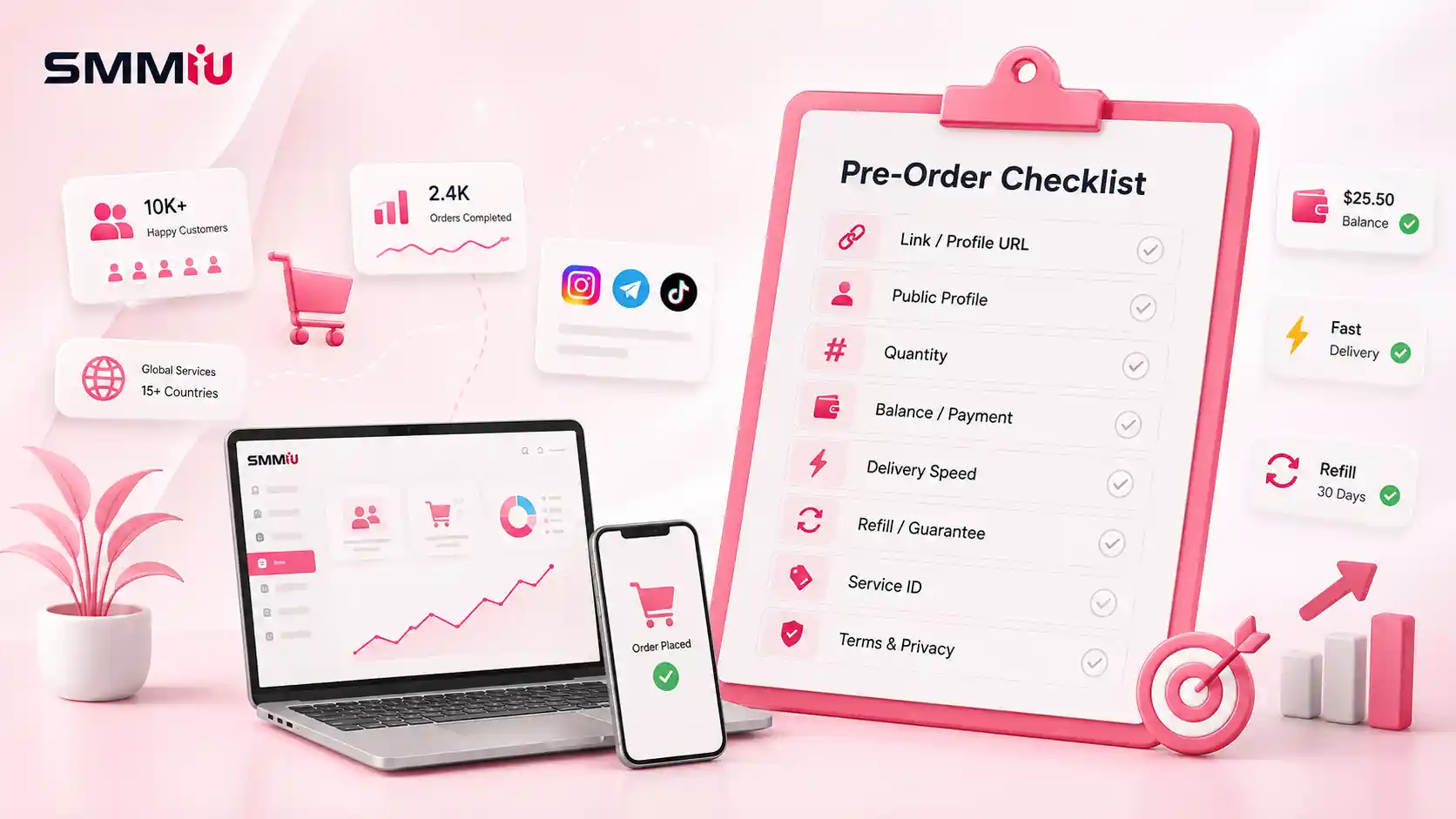
Before clicking submit, confirm all of the following:
- The selected metric matches your campaign goal.
- The service supports the correct platform and target type.
- The profile, post, video, page, or group is public.
- The URL is correct and opens in a separate browser window.
- The quantity is within the minimum and maximum limits.
- The cost, currency, and balance deduction are clear.
- You understand the estimated start and delivery rate.
- You have checked whether the service is refill or no-refill.
- There is no active order for the same metric and link that could affect tracking.
- You have saved the starting count and service ID.
- The order does not depend on a guarantee of virality, sales, or monetization.
- The service and intended use comply with the target platform’s current rules.
This short review prevents many of the issues beginners later report as panel failures.
SMM Panel vs Organic Growth vs Paid Ads
These methods solve different problems, so one should not be presented as a complete replacement for the others.
A balanced campaign uses several of these. For example, a business can publish a helpful video, run an ad to a relevant audience, use analytics to measure watch time, and place a small panel order for a clearly defined presentation goal. Each tool should have its own purpose and success metric.
How to Choose a Reliable SMM Panel
Do not judge an SMM panel by price alone. Check whether its services clearly explain delivery time, order limits, refill terms, and link requirements. A reliable panel should also provide secure payments, responsive support, and clear refund or cancellation policies. It should never ask for your social media password.
Before adding a large balance, place a small test order and monitor its delivery, retention, and support response. You can follow our complete guide on how to choose a reliable SMM panel for a detailed checklist.
Final Thoughts
An SMM panel is an ordering dashboard for social media services. That is the whole thing. It is not a growth strategy, it is not a marketing agency, and it is not a shortcut around building something people want to follow.
Used with judgment, it does a specific job well. It gets a new page past the point where it looks abandoned. It gives a good post the early traction it needs to be taken seriously. It saves an agency hours of manual work.
Used without judgment, it inflates a number, kills an engagement rate, and occasionally costs someone an account they spent years building.
So if you are going to use one, use it the boring way. Start with the minimum order. Turn on drip-feed. Read the service description. Check the refill window. Keep your password to yourself. And keep making content, because that is the part that was always doing the real work.
Frequently Asked Questions
Do SMM panels use bots?
Some services do, especially the cheapest ones. Better services use aged or partially active accounts. No panel can honestly promise every account is a genuine engaged user, so treat that claim as marketing.
Why are SMM panel prices so low?
Because most panels are resellers buying in bulk from larger providers through API connections, wholesale rates are extremely low, and panels compete on thin margins across high order volume.
What is the difference between an SMM panel and a reseller panel?
An SMM panel sells to end users. A reseller panel is built for people who resell those services to their own customers, usually with wholesale pricing, API access, and mass ordering.
Will an SMM panel ever need my password?
No. A legitimate panel only needs your public profile, post, video, or channel link. Any panel asking for your social media login is a scam, without exception.
What is drip-feed in an SMM panel?
Drip-feed schedules delivery in smaller batches over a selected period instead of sending the full quantity at once. It is useful for pacing and recurring campaigns. It does not guarantee safety or compliance, so the user must still follow platform rules and choose suitable quantities.
Can I make money by reselling SMM panel services?
Yes, many people do. You buy at wholesale rates through a reseller or child panel and sell at retail. Margins are thin, so it works on volume, reliability, and customer support rather than on one-off sales.
Share