
Share


The main advantages of using an SMM panel are faster visible activity, lower-cost testing, social proof, and easier management of services across multiple platforms. The disadvantages include less predictable service quality, potential drops, unnatural-looking activity, and platform policy concerns.
For creators, businesses, freelancers, agencies, and resellers, an SMM panel can be a convenient option. However, it works best as a supporting tool. It cannot replace useful content, genuine audience interest, paid advertising, or a complete marketing strategy.
Advantages of Using an SMM Panel
The main advantages of SMM panel services are convenience, faster visible activity, affordable entry costs, multi-platform access, and easier order management.

The value depends on how you use the panel. A creator may care about initial visibility, while an agency may value centralized order management more.
Faster Visibility
A newly published Reel, TikTok, YouTube video, Facebook post, or business page often begins with very little visible activity.
SMM panels provide services such as views, likes, reactions, followers, subscribers, and other platform-specific metrics. These services can increase visible numbers more quickly than waiting for them to grow naturally.
This can help when a user wants a new post or profile to look less empty.
However, visible activity and organic reach are different things. Increasing a metric does not guarantee that the platform will recommend the content or that real users will respond to it.
How SMM Panels Can Support Social Proof
People often use visible activity as one signal when deciding whether a profile looks established. A business page with regular posts, followers, views, and some engagement can make a different first impression from an empty account.
An SMM panel can support that visible social proof. The numbers still need to make sense, though.
A profile with 20,000 followers, three posts, and almost no engagement may appear less natural than a smaller account that publishes consistently and receives believable interaction.
So social proof works best when it supports an active profile rather than compensating for a lack of content.
Lower-Cost Testing for Small Budgets
Many panels allow users to place relatively small orders instead of committing a large marketing budget at once. This can be useful for:
- small businesses,
- new creators,
- freelancers,
- agencies,
- resellers,
- and people comparing services.
A small order allows the user to observe how the service performs before committing more money.
It is still important not to assume that the lowest price offers the best value. Pricing, provider source, delivery conditions, and service tier can all affect what the buyer receives.
Multiple Platforms in One Dashboard
One practical advantage of an SMM panel is that multiple services can be managed from a single account. Depending on the panel, services may be available for:
- TikTok
- YouTube
- X
- Telegram
- Other supported platforms
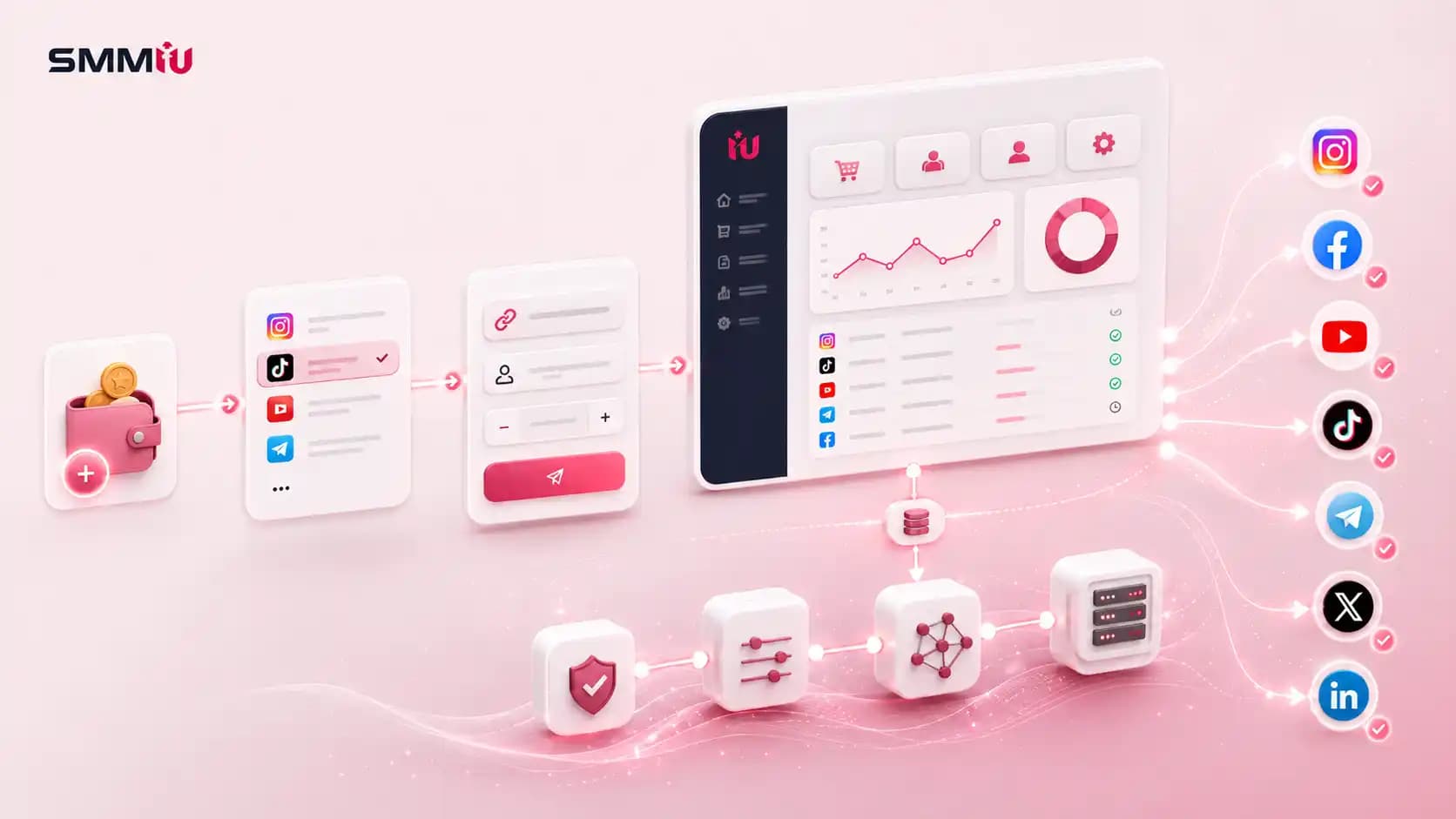
Instead of opening separate websites for each network, the user can usually choose a service, enter the target, specify the quantity, and check the order status from the same dashboard.
For people managing several social accounts, that can make the workflow much easier.
Saves Time for Agencies and Freelancers
Agencies and freelancers may handle several client accounts at the same time.
One customer may need an Instagram service, another a YouTube service, and another a Telegram or LinkedIn order.
A centralized panel can make these orders easier to organize.
Features such as order history, bulk ordering, balance tracking, and status monitoring can reduce repetitive administrative work.
The panel therefore has value not only as a source of services but also as an order-management system.
Reseller and API Access
Some SMM panels also support resellers who offer services through their own websites or customer base.
API access can automate parts of that workflow by allowing compatible systems to submit orders and retrieve status information without manually copying every request between dashboards.
That is only one benefit of API integration, so it does not need to be explained deeply here.
For the complete technical workflow, see What Is API in SMM Panel?
Disadvantages of Using an SMM Panel
The main disadvantages are inconsistent service quality, drops, unnatural-looking activity, platform restrictions, and the risk of choosing a poor provider.

These issues deserve attention, but each one belongs to a larger topic of its own. This article only covers how they affect the overall pros and cons decision.
SMM Panel Service Quality Can Vary
Not every service within an SMM panel operates the same way. For example, one dashboard might contain:
- Instagram Followers – No Refill
- Instagram Followers – 30-Day Refill
- Instagram Followers – Fast Delivery
- Instagram Followers – Country Targeted
- Instagram Followers – Premium
Although they belong to the same general category, their provider source, delivery conditions, limits, and price may differ.
This is one reason the service description matters more than simply choosing the cheapest listing.
Followers, Likes, or Views Can Drop
Some delivered metrics may decrease after an order.
Users can unfollow, accounts can disappear, providers can change, and platforms can remove activity they consider invalid.
Refill may be available on some services, but a refill condition does not mean the metric is permanently guaranteed.
The detailed reasons and possible order statuses belong in Why SMM Panel Orders Drop or Fail rather than being repeated here.
Large Sudden Changes Can Look Unnatural
The amount and speed of an order can affect how natural the profile appears to a visitor.
For example, an account with 60 followers and very little content suddenly jumping to several thousand followers may create an obvious mismatch between its visible audience and its normal activity.
The disadvantage is therefore not simply “more numbers.” It is the possibility that the numbers no longer fit the profile.
Some Services Can Conflict With Platform Rules
Social platforms set their own rules for artificial or manipulated engagement.
YouTube states that artificially increasing views, likes, comments, subscribers, or other metrics through prohibited methods is not allowed. It also warns creators that actions taken by third-party promoters can affect their channels.
TikTok similarly says it does not allow fake engagement or the trade and marketing of services designed to artificially increase engagement, including followers and likes.
or the trade and marketing of services designed to artificially increase engagement, including followers and likes.
or the trade and marketing of services designed to artificially increase engagement, including followers and likes.
The important distinction is that an order being marked Completed by a panel does not mean the social platform has approved the activity. Users should check the current rules of the platform they are using.
Poor Panels Can Waste Money
The panel itself can also be the problem.
Weak support, unclear service descriptions, stuck orders, confusing policies, or services that do not perform as described can turn an inexpensive order into poor value.
This is mainly a provider-selection issue.
Account and Password Risks
Most standard SMM panel services use a public target such as a profile, post, video, or channel URL.
A request for your social media password, email password, 2FA code, or recovery information poses a different level of risk and should be treated with caution.
Account security warrants its own explanation; see "Are SMM Panels Safe?" for a detailed discussion of safety.
SMM Panel Pros and Cons at a Glance
| Advantages | Disadvantages |
|---|---|
| Faster visible activity | Service quality can vary |
| Can support social proof | Metrics may decrease later |
| Allows small-budget testing | Large changes can look unnatural |
| Multiple platforms in one dashboard | Some services may conflict with platform rules |
| Saves administrative time | Weak providers can waste money |
| Useful for agencies and resellers | Account-security risks exist with poor providers |
| API can automate reseller workflows | Results beyond delivery remain uncertain |
When Should You Use an SMM Panel?
An SMM panel makes more sense when you already have content or a marketing plan and need support for a specific metric or workflow.
Possible situations include:
- supporting the launch of a new post or profile,
- adding initial visible activity,
- managing orders for several accounts,
- testing a service with a limited budget,
- handling reseller orders,
- or centralizing services from several platforms.
For example, a business that already publishes useful content may use a panel for a specific supporting task.
That is different from creating an empty profile and expecting purchased metrics alone to create a successful brand.
When Should You Avoid Using an SMM Panel?
Avoid relying on an SMM panel when the service is unclear, the provider appears unsafe, or your real goal requires genuine customer actions rather than a change in visible metrics.
It is a poor fit when your expectation is:
- guaranteed sales,
- guaranteed virality,
- guaranteed loyal customers,
- permanent organic growth,
- or a replacement for content and marketing.
Likewise, avoid providers that request unnecessary login credentials or do not clearly explain what a service includes.
For payment and provider checks before spending money, see What to Check Before Adding Funds.
Four Basic Precautions Before Using an SMM Panel
You do not need a full safety checklist inside a pros-and-cons article. Four basic precautions cover the most important points:
- Read the service description before ordering. Check what the service actually includes rather than relying on its name.
- Begin with a limited test when using an unfamiliar service. This gives you information before increasing spending.
- Keep login credentials private. Standard link-based services normally should not require your social media password or 2FA code.
- Check the platform rules. A panel's service conditions and a social network's policies are separate things.
SMM Panel vs Paid Ads: What Is the Difference?
SMM panels and paid social advertising are not substitutes for the same marketing function. An SMM panel mainly supplies specific social metrics or services, while paid advertising is designed to reach selected audiences and optimize toward campaign objectives.

This is an important distinction because both involve spending money on social media, but the money is buying very different things.
| SMM Panel | Paid Social Ads |
|---|---|
| Usually purchases a defined social metric or service | Purchases advertising distribution |
| Order is based on quantity and target URL | Campaign is based on audience, creative, budget, placement, and objective |
| May increase visible metrics | Can put an offer in front of selected audiences |
| Usually charged by service quantity | Usually charged through an advertising auction |
| Does not create a conversion funnel by itself | Can optimize toward business actions |
| Limited control over who ultimately interacts | Advertisers can use targeting and campaign settings |
| Commonly used for metric support or reseller workflows | Commonly used for awareness, traffic, leads, app activity, and sales |
Meta's own advertising materials describe objectives including awareness, reach, traffic, engagement, app installs, video views, conversions, and catalogue sales.
That explains the core difference.
Imagine an online clothing store.
With an SMM panel, the store might purchase a defined number of reactions or another available social service for a post.
With paid advertising, the store can create an ad, select an audience, show the product to potential buyers, and optimize the campaign around a business objective.
The first changes or supports a social metric.
The second is an audience-acquisition system.
Which Is Better for Sales?
For direct sales, leads, website traffic, or app installs, paid advertising is generally the more appropriate tool because those outcomes can be built into the campaign objective and measured through the advertising platform.
An SMM panel should not be presented as a replacement for that process.
Which Is Better for Visible Social Proof?
An SMM panel is more directly focused on specific visible metrics.
Paid advertising can also generate engagement, views, followers, and awareness, but those may come as part of reaching actual users through an advertising campaign rather than purchasing a predefined metric quantity.
Can Businesses Use Both?
They serve different roles, so technically a business may use different promotional methods within a broader strategy.
The important point is not to confuse what each tool is supposed to accomplish.
If the objective is customer acquisition, evaluate the channel by leads, conversions, acquisition cost, and revenue.
If the objective is a specific social metric, evaluate that service according to its own terms.
Final Thoughts
SMM panels offer real practical advantages: convenience, centralized management, lower-cost testing, visible social proof, reseller workflows, and faster changes to selected metrics.
They also have limitations. Service quality varies, metrics can change later, some activity can look unnatural, and platform policies may restrict certain forms of artificial engagement.
The right question is therefore not whether SMM panels are simply “good” or “bad.”
It is whether the specific advantage you want is worth the limitation that comes with it.
Use the panel for the job it can actually perform, and use content, advertising, SEO, community building, and other marketing channels for the jobs they do better.
Frequently Asked Questions
Is an SMM panel worth using for a brand-new account with no content?
Usually, content should come first. Adding visible numbers to an empty profile does little to explain who you are, what you offer, or why someone should follow you. A panel makes more sense when the account already has enough content to give new visitors something useful to explore.
Do the disadvantages of SMM panels apply equally to every social platform?
No. Each platform has different metrics, recommendation systems, policies, and enforcement methods. A service involving YouTube views does not have exactly the same conditions or risks as one involving Telegram views or another platform.
If I stop using an SMM panel, will the numbers stay?
There is no universal answer. Some metrics may remain, while others can decrease because users leave, accounts disappear, providers change, or platforms recalculate activity. The individual service conditions are more useful than assuming every order behaves the same way.
Can an SMM panel and paid advertising be used for the same campaign?
They serve different functions. Paid ads can target audiences and optimize toward marketing objectives, while an SMM panel generally provides a predefined social service. If both are used, their results should be measured separately rather than treated as the same traffic or acquisition source.
Is the cheapest SMM panel always the best value?
No. The lowest listed price does not show delivery conditions, provider quality, support, service limits, or other differences. A lower-priced service can be useful, but price should be compared with what the service actually includes.
Can an SMM panel replace organic social media marketing?
No. Organic marketing involves content, audience relationships, brand voice, community interaction, and ongoing communication. An SMM panel may support selected metrics, but it cannot perform those broader marketing functions.
Share